

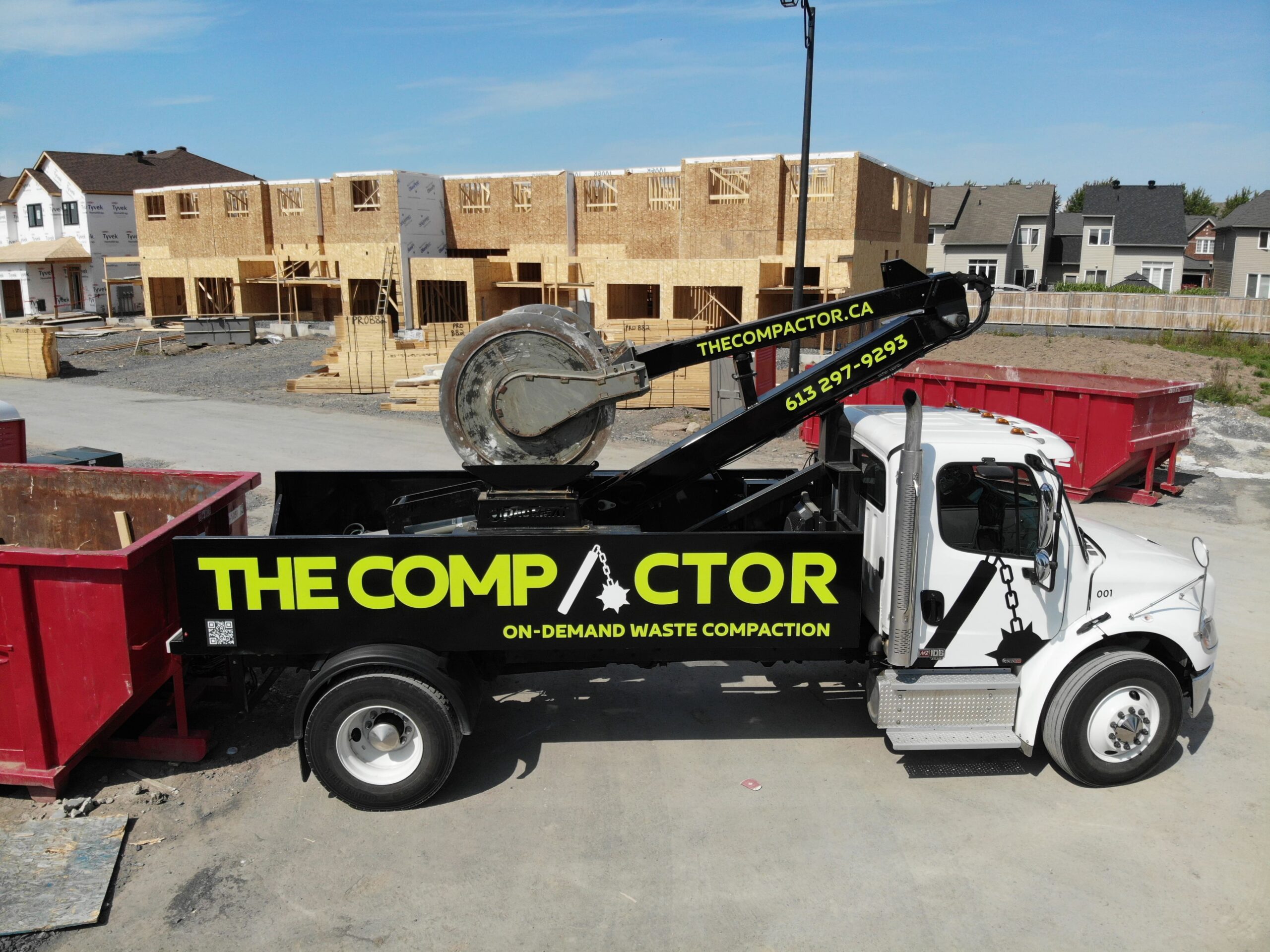
If your business in Ottawa or Gatineau is paying too much for waste management, frequent dumpster hauls, overflowing roll‑offs, or under‑used bins — switching to on‑site mobile waste compaction could deliver tangible savings. In this post, we’ll walk through five key cost savings your business can realize when you shift to a compaction‑based model.
1. Fewer dumpster hauls = lower haul cost
One of the most direct cost savings comes from reducing the number of times your roll‑off bin needs to be hauled away. In the traditional model, you fill a bin, call your hauler, they remove and replace it — and you pay each time. But with on‑site compaction, you’re able to pack more waste into each haul, meaning fewer hauls overall.
For example, providers of mobile compaction services report volume reductions of up to 70‑80 % in some cases. That means if you were doing 12 hauls a month, you might reduce that to six or eight. Fewer hauls equals fewer bills from your hauler.
In Ottawa & Gatineau, where hauling distances, disposal fees, and labor costs may be elevated compared to smaller regions, reducing haul frequency can make a meaningful difference to your bottom line.
2. Better bin‑space utilization (up to ~85 %)
A big issue many businesses overlook is that a dumpster often contains a lot of “air” — large items (pallets, boxes, plastics) don’t settle well, so volume is wasted. On‑site compaction re‑packs and crushes the waste, so you use more of the bin’s capacity.
For instance, one service reports up to 85 % more usable space in the same bin, and a typical average savings of 40‑70 %. That means you’re essentially hauling more waste for the same price or delaying the need for the next haul.
If you currently rent multiple bins because each fills too quickly, switching to a compaction model may allow you to consolidate, reduce bin‑rental cost, and optimize your footprint.
3. Lower risk of overflow fines and emergency hauls
Overflowing bins are not just a mess — they can also trigger extra costs: emergency pick‑ups, penalties from haulers, fines from municipalities, and disruption of operations. A compaction service helps stretch your bin’s capacity, reducing the chance you hit overflow and need an unscheduled haul.
As one blog notes, “overflowing dumpsters are a safety risk… reducing volume helps keep your business clean, safe and cost‑efficient.” Fewer emergency hauls means you avoid the premium cost of “rush” service, and you keep your schedule predictable.
4. Less operational disruption & lower labor cost
Haul trucks coming, bins being swapped, downtime waiting for the pick‑up — these interrupt operations, especially in tight facilities. On‑site compaction often takes minutes, not hours, and doesn’t require you to ship out a bin and wait for a replacement.
A recent article states that implementing mobile compaction “reduces the number of hauls you need to coordinate… fewer disruptions, fewer wasted employee hours.” That means your staff can focus on their core tasks rather than managing waste logistics or waiting for a bin swap.
In the context of Ottawa & Gatineau, where labor and municipal service rates might be higher than in some rural areas, this operational efficiency becomes even more valuable.
5. Sustainability and brand value – indirect cost benefits
While this may not be a direct line item in your monthly invoice, switching to on‑site compaction can enhance your sustainability credentials — fewer haul‑truck trips, less fuel use, reduced carbon footprint. These benefits can translate into better brand perception, better relationships with clients, and potentially lower regulatory or disposal‑fee exposure.
For example, one service provider highlights that reducing hauls can form part of a company’s ESG (Environmental Social Governance) strategy. In Ottawa & Gatineau, where many organizations are under pressure to show environmental leadership, this can boost your positioning and potentially help you win contracts or reduce compliance risk.
Also, compacting more waste in fewer trips means less energy per ton of waste removed — so you’re doing more with less. That efficiency translates into cost‑savings over time, even if it’s less visible on your monthly waste invoice.
How to estimate your savings
Wondering how to quantify what you might save? Here’s a simple approach:
- Review your current waste‑haul cost: how many hauls per month × cost per haul.
- Estimate improvement: assume volume reduction of 40–70 % (based on provider data) and calculate the new haul count.
- Multiply the new haul count × cost per haul to get the forecast cost.
- Subtract forecast cost from current cost = estimated monthly savings.
For example, if a business was doing 10 hauls/month at CAD \$600 each → CAD \$6,000/month. If compaction reduces hauls by 50 % → 5 hauls × \$600 = \$3,000/month → savings of \$3,000/month or \$36,000/year.
Also factor in improvements like fewer emergency fees, reduced bin‑rental needs, lower labour disruption — these are harder to quantify but real.
Which types of businesses in Ottawa & Gatineau benefit most?
On‑site mobile compaction is especially relevant for businesses that:
- Use roll‑off dumpsters (10 yd–50 yd) and fill them with general waste, cardboard, plastics, light metals, and pallets.
- Have high haul‑frequency or overflow issues.
- Operate in space‑constrained areas or dense urban/suburban locations (e.g., Ottawa, Gatineau) where bin‑space is premium.
- Have sustainability goals or are under pressure to demonstrate environmental leadership.
If you’re a retail store, warehouse, construction site, manufacturing unit, or distribution center in the Ottawa / Gatineau region, switching to mobile compaction could deliver disproportionate savings compared to small low‑volume sites.
What to look for when picking a compaction partner
When evaluating a partner for on‑site compaction in Ottawa & Gatineau, ensure you compare the following:
- Local service & quick response: Same‑day or next‑day service in Ottawa & Gatineau ensures you maximize efficiency.
- Machine compatibility: The machine should be capable of working inside your bin size (10–50 yd typical) and handle your waste stream (cardboard, pallets, plastics, etc.).
- Transparent pricing: Clear cost‑structure based on bin size, haul‑frequency, service area (Ottawa & Gatineau) — avoid surprise “extra” fees.
- Minimal disruption: Service should be quick (minutes rather than hours) and avoid hindering daily operations.
- Environmental credentials: If sustainability is a priority, ensure the provider tracks volume reduction, haul trips saved, and is willing to share results.
Next steps — turning insight into action
If you’re ready to explore switching to on‑site compaction, follow this action plan:
- Pull your current waste‑haul data: number of hauls/month, cost/haul, bin size(s), overflow incidents.
- Contact a reputable compaction‑service provider in Ottawa & Gatineau and request a quote with estimated haul‑reduction data.
- Compare your current cost vs the proposed compaction model, including projected fewer hauls, fewer emergency fees, and better bin-utilization.
- Implement a pilot: choose one or two bins, apply compaction service for 30‑90 days, monitor results (haul‑count, cost, overflow, disruption).
- Review results and scale: if savings are realized, roll out across other bins or locations; if not, adjust service frequency or provider.
By making the switch, you could reduce your waste‑management cost not just by a few hundred dollars a month, but by thousands, with knock‑on benefits in efficiency, sustainability, and operations.
Conclusion & call to action
Every business in the Ottawa & Gatineau area deserves a waste‐management solution that is efficient, cost‑effective, and aligned with operational and sustainability goals. By adopting on‑site mobile waste compaction, you stand to gain **five major cost savings**: fewer hauls, better space use, reduced overflow risk, lower labour/operational disruption, and improved sustainability credentials.
If you’re ready to quantify the savings for your operation, contact us today and let us walk you through your current waste strategy and how on‑site compaction could slash your costs.